THIS IS A COMPLETE DRAFT. IT WILL LATER GET REDESIGNED
SYLLABUS
Introduction
The primary purpose of this grading syllabus is to provide every Kohai, Sempai, Sensei, Examiner with a clear understanding of the individual standards and requirements needed for each grade within Jundokan Lithuania Russia. However, it is of equal importance to explain why there is a need for such a syllabus and the reasons behind it.
The basis for the grading system we use today was brought about because of the modernisation of the Japanese Martial Arts in the 1930’s. The aim was to create a standard system for all the Martial Arts of Japan. Consequently, the Kyu/Dan system came into existence.
Within Jundokan Lithuania Russia there are seven Kyu Rank levels, starting with Nana Kyu (7th Kyu) and progressing through to Ichi Kyu (1st Kyu). The Kyu Rank system is structured in such a way as to enable Karate Ka to progressively learn, refine, develop the physical and mental fundamentals needed for Karate Do. The physical fundamentals required are physical fitness, the ability to perform effective, dynamic techniques reflecting the principles of Goju Ryu and basic fighting skills, all to be performed to a good standard for the respective rank. Because of the combative nature of Karate Do it is also vital for the Karate Ka develop an indomitable spirit, also known as Karate Spirit. The true spirit of Karate Do can only be forged by austere training. The mental attributes that are needed for the realisation of Karate Spirit are mental focus, perseverance, determination, courage. Only when all these fundamentals have been refined and develop will the Karate Ka then able pass into the Dan Rank system.
There are Ten Dan Ranks, starting with Sho Dan (1st Dan) and progressing through to Ju Dan (10th Dan). Using the fundamentals which were developed in the Kyu grade system as a strong foundation, the Karate Ka will then go onto further strengthen and refine their Karate Do. In fact, the attainment of Sho Dan is seen as only the first stage in a very long journey of development and refinement which will eventually lead to mastery. Master Jigoro Kano, the founder of Judo and the Kyu/Dan grade system, felt it important for all practitioners of the Martial Arts to realise that one’s training was in no way complete upon the achievement of Sho Dan. Moreover, he emphasised that on the contrary the attainment of Sho Dan grade merely symbolised the real beginning of a long hard journey towards self-mastery.
Master Shoshin Nagamine, the founder of Matsubayashi Ryu Karate Do, states that “Mastery of Karate Do require dedication and strenuous effort. To pursue Karate Do means to seek to master ones-self. The true study of Karate Do must transcend the mere physical; it must become a way of life.”
With this in mind, we have devised a grading syllabus that will help guide, evaluate, reflect the progression of individual Karate Ka.
A GUIDE TO HOW THE GRADING SYLLABUS SHOULD BE EMPLOYED
THE IMPORTANCE OF THE SYLLABUS
This section is designed to give a clear and practical guide to all Kohai, Sempai, Sensei, Examiners as to how the Syllabus should be used.
The individual levels that are contained within this syllabus are aimed at adult Karate Ka who are healthy, physically fit and in their prime. However, not everyone fits in to this category. Children require a special type of training regime. Ageing, injuries, ill health, will with the passage of time effect everyone to some degree. Karate Do is a lifelong pursuit and as a result these factors must be taken in to account within the grading system. Therefore, it is important to give guidelines to Sensei, Examiners regarding these factors. These guidelines are talked about in this section under the title “Special Considerations for Examination.”
ALL KARATE KA
Karate Ka are encouraged to use the Syllabus for the following reasons:
- To assess their own training in relation to the fundamentals that are required for progression within Goju Ryu.
- To gain a deeper understanding of the principles of Goju Ryu.
- To set obtainable goals.
- To help prepare for examination.
- To help create individual training regimes based upon the requirements needed for examination.
- Discover their weaknesses and strengths.
SENSEI
Sensei should use the Syllabus a guide for the following reasons:
- To assess the development of their students both physically and mentally.
- To encourage students to have a deeper understanding of the principles of Goju Ryu.
- To set obtainable goals for their students.
- As a guide to the way training sessions should be structured and taught within their Dojo.
- In the preparation and recommendation of their students for grading examination.
- To help students create their own individual training regimes based upon the requirements needed for grading and their own weaknesses and strengths.
GRADING EXAMINERS
Examiners within Jundokan Lithuania Russia are only allowed to examine up to the rank of San Dan. Kyu Grade Examinations can only be conducted by a panel of a minimum of three Examiners who are of the rank of San Dan or above. Dan Grade Examinations can only be conducted by a panel of three Examiners who are of the rank of Go Dan or above. Examiners are required to employ the Syllabus for the following reasons:
- To give the specific requirements that is needed for each individual grade to be examined.
- To help in assessing the character of individual Karate Ka.
- To give an assessment of the student’s weaknesses and strengths.
- To help set standards of competence for all Dojo’s within the Association.
- To inspire and reward successful Karate Ka (in a non-egotistical way) for their hard work, dedication, loyalty to Okinawan Goju Ryu.
SPECIAL CONSIDERATIONS FOR EXAMINATION
JUNIOR AGE GROUP
Great care and consideration must be given to the training of junior Karate Ka under the age of sixteen. With adults, personal responsibility about health, physical fitness and injuries is expected. However, junior students are the sole responsibility of the Sensei, Sempai in their charge. It is therefore essential, that all Sensei, Sempai are made fully aware of their responsibility about the children they teach and that they conduct their Dojo training sessions accordingly.
It must be remembered that children are not miniature adults. Because children’s physiology, mental concentration is different to that of adults, it is important to recognise that their level of fitness level, their ability to train for an extensive period will be reduced. They are building new tissues and consequently have less energy available. Therefore, a child will only able to sustain low levels of training. Also, children’s bones and joints are not fully formed; as a result, austere training can cause permanent injury. Consequently, junior Karate Ka should refrain from austere training and the following practices:
- Press-ups on knuckles or backs of hands.
- Makiwara.
- Over flexing of muscles (all flexibility exercises must be accompanied with muscle building exercises).
- Power training including Hojo Undo exercises.
- Ballistic exercises.
- Uncontrolled sparing (sparing must always be controlled to avoid injury).
- Body conditioning exercises such as Tai Kitae.
Junior Karate Ka are only allowed to be examined up to the rank of Junior Sho Dan. When examining Junior Candidates, Examiners will use the Syllabus as read excluding all the practices listed above. Upon reaching the age of sixteen a Karate Ka may be recommended by their Sensei for the rank of Senior Sho Dan. They will then have to undergo a retest which will include all aspects of Goju Ryu as laid down in the Syllabus.
ADULTS
- “When you are in your twenties, train as a twenty-year-old.
- When in your forties, train as a forty-year-old.
- When you are sixty, train as a sixty-year-old.”
This saying states the obvious and is just common sense. However, its true meaning must be understood, and not distorted to be used as an excuse by Karate Ka not to fulfil their full potential as they grow older. What makes true Karate Do so great is that one is always striving to achieve. No matter what age, a Karate Ka must always train with Karate Spirit; once this spirit ceases to exist the Karate Ka is no longer practising Karate Do. It is also important for Karate Ka to both respect and be aware of their body’s limitations about their health and age. The Dojo Kun that reflect this attitude; are “Train yourself considering physical strength” and “Take care of yourself.” Therefore, as one grows older a balance must be struck between training hard with Karate Spirit and being aware of the body’s limitations.
Master Shoshin Nagamine was greatly affected by the words of his teacher Master Chotoku Kyan in relation to this. In his book The Essence of Okinawan Karate Do, he quotes Master Kyan words, “Mastery of Karate does not depend on the learner’s physical constitution, but mainly on constant practice,” also “Merely an excellent physical constitution cannot guarantee a mastery of Karate Do.” One example he gave concerned the development of the fists as weapons: “The daily practice of makiwara can produce power destructive enough to break boards and bricks, but powerful fists can easily be weakened through negligence of constant practice.” This is true about Karate Do as a whole. Master Eiichi Miyazato is quoted as saying “The only secrets in Goju Ryu are the ones you discover for yourself.” Therefore, only through diligent practice, constant hard work and a strong will can one realise the secrets of Karate Do and discover its beauty.
Medical experts, recommend that anyone over the age of forty should always check first with their doctor, before engaging in any physical activity such as Karate Do. It is important that Karate Ka between the ages of sixteen to forty train with austerity, while Karate Ka over the age of forty should train hard but with awareness of their own physical limitations. It is important to make the point that all adult Karate Ka are responsible for their personal health and physical fitness. However, it is also the responsibility of all Sensei, Sempai to be aware of the physical limitations of the individual Karate Ka in their care. During examination Candidates between the ages of sixteen to forty will therefore be tested with austerity in mind. However, Candidates over of the age of forty, their health and physical fitness will be taken in to consideration by Examiners.
DISABILITIES AND HEALTH ISSUES
It must be stressed that individuals who have a disability or health issues must always check first with their doctor first before participating in Karate Do training. If Karate Do training can be seen to be of benefit, then an individual should be encouraged to start training. Sensei, Sempai must always be made fully aware of any issue that an individual may have and how it will affect their Karate Do training. Candidates who have a disability or health issue, must not be discriminated against when it comes to promotion. Examiners will consider any issue that will affect the Candidate to be examined. A Candidate will not be asked to demonstrate anything that will be detrimental to their disability or health.
GRADING REGULATIONS OF THE SO HONBU, JUNDOKAN OKINAWA
In August 2004 the Headquarters of the Okinawan Goju Ryu Karate Do, So Honbu Jundokan, based in Okinawa, Japan decided that all grading’s above the rank of 3rd Dan must be carried out by no less than two instructors from the So Honbu, Okinawa, Japan. Please refer to the Articles below about grading’s above the rank of 3rd Dan.
Article 4
Grading’s from outside of Okinawa must be accompanied by current grade certification. The Chairman of the grading committee reserves the right to grade any individual deemed fit regardless of the persons years of training or the number of years elapsed since their last grading.
Article 5
- In order to hold a grading at the Jundokan the Rank and Grade Examination Committee (hereinafter referred to as the Grading Committee) must be convened.
- The Chairman of the Grading Committee shall be the Kancho of the Jundokan.
- The Grading Committee shall consist of no more than 10 members and be made up of those chosen by the chairman who hold a rank of 7th Dan and above.
- The Grading Committee may only be convened by the Chairman and shall have a quorum of five members.
- A test for the rank of Hanshi 10th Dan shall be conducted by the Chairman and an existing 10th Dan.
Article 6
Grading’s shall be held as follows:
- Grading’s will be held twice yearly.
- Should the Chairman of the Grading Committee deem it necessary, a special grading made be held.
- Affiliate Dojo’s may grade members up to 3rd Dan. Grading’s of 4th Dan and above must be carried out by no less than two instructors from the So Honbu.
Article 7
Grading and certification fees are set forth in a separate document.
Supplementary regulations
- The revision or annulment of these regulations may be carried out only by direction of the Board of Directors after thorough discussion by the Grading Committee.
- The regulations shall take effect on August 2004.
CRITERIA FOR GRADE PROMOTION WITHIN JUNDOKAN LITHUANIA & RUSSIA
Candidates applying for promotion and the Sensei who recommend them must fulfil the following criteria:
Candidates must:
- Be a full member of the Okinawan Goju Ryu Karate Do, Jundokan Lithuania Russia.
- Be training on a regular basis at an official Jundokan Dojo.
- Embody the true spirit of Karate Do.
- Try and live by the principles expounded in the Jundokan Dojo Kun.
- Be of good character.
- Be a full member of their Dojo.
- Commit fully to the test, performing to the best of their ability with Karate spirit, to do otherwise will only lead to failure. (Exceptions will be given to individuals who have a disability or health issue, which may affect their ability to perform specific techniques or other any other requirements. Any issues relating to this must be reported to the Examiners before the test takes place. The age of a Candidate will be taken into consideration.)
Sensei who recommend their students for promotion must ensure that:
- Kyu grades have attended the required amount of training sessions and complied with the set time between grades.
- Dan grades must have attended the required amount of training sessions. They have also completed the required time since their last promotion.
- They are of the required standard.
- Each Candidate has acquired the required skill level in each aspect that they are to be tested on.
- Each Candidate has a clear understanding as to all the requirements expected of them and the process of the test. (It is therefore important that Candidates have rehearsed their test in advance, and it is the responsibility of their Sensei to ensure this by giving advice, as well as allotting Dojo time and space for the Candidate to rehearse beforehand.)
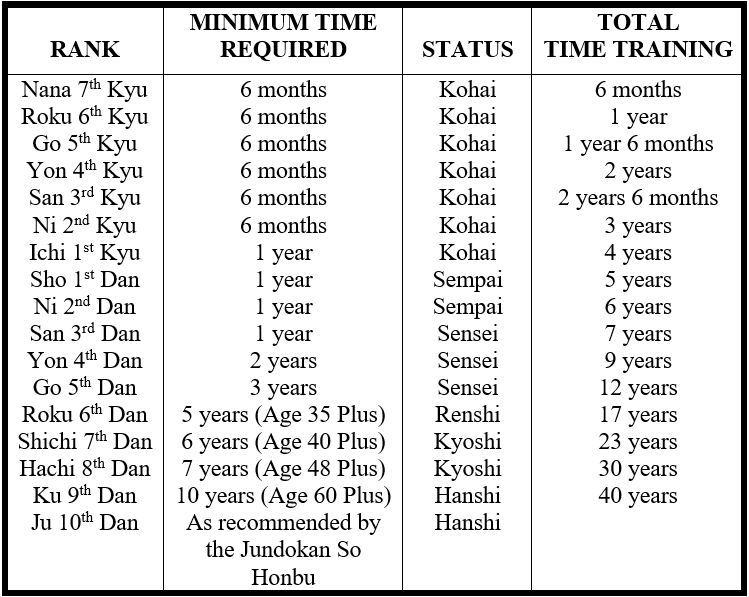
TIME INTERVALS BETWEEN GRADES
The time intervals Given are the required minimum periods. Candidates for examination must have attended 6 Dojo class sessions per month (Gasshuku will be considered), or a minimum of 36 Dojo sessions over a 6-month period.
Attainment of a Grade is the result of a process of continual assessment; therefore, a Karate Ka who does not work to the best of their ability consistently must not be recommended for examination by their Sensei. It must be remembered that there is no shame in not being put forward for, or failing to pass a grading examination, it is only a reflection of the fact that the Karate Ka is not yet ready to progress on to the next grade. Karate Ka should learn from their weaknesses and in so doing strengthen themselves, hence the saying “We should convert our weaknesses into strengths and our strengths into super strengths.”
The time spans that are quoted are the minimum requirements. However, if a Karate Ka attends more classes than the minimum, progression through the Kyu Ranks might be quicker but only if the Karate Ka applies themselves correctly (This only applies to Kyu Ranks).
KARTE KA FROM OTHER ASSOCIATIONS OR STYLES
The rank of individual Karate Ka from other Goju Ryu associations or other Karate Do styles will be respected by Jundokan Lithuania Russia and they will be allowed to wear their respective belts within association Dojo’s. However, they will only be allowed to take a promotion within Jundokan Lithuania Russia up to the rank of 3rd Dan when they are of the appropriate standard as set down in the Grading Syllabus, they have fulfilled all the criteria for rank promotion and only on the recommendation of their Sensei. Candidates for promotion will be examined on the stated requirements for the rank they are recommended for. Nevertheless, they may also be required to demonstrate and be examined on any of requirements for previous ranks, this will be at the discretion of the Examiners.
KATA
According to Master Chojun Miyagi, Kata can be divided into Heishu, fundamental Kata and Kaishu dynamic, advanced Kata. Heishu Kata of Goju Ryu are Sanchin, Sanchin Dai Ni, Tensho, these Kata act as an opening, developing in Karate Ka the skills, conditioning that are fundamental in the ability to assimilate more advanced Kata. These Kata aim to develop correct posture, breathing, strength development and a fighting spirit. Kaishu Kata form the rest of the Kata within Goju Ryu, they have a much more pronounced combat aim and as such are carried out in a much more dynamic way, allowing, and empowering the flow of energy through the essential principle Go and Ju.
Kata is the foundation upon which all aspects of Goju Ryu are based. Therefore, the practice of Kata is essential to all Karate Ka no matter what rank they are. Kata requires continues practice, diligent study, and research to refine and unravel the secrets of Goju Ryu.
During examination, Candidates should only perform the Kata as passed down to us from Master Eiichi Miyazato in its true form.
Because of its importance, any mistake made in Kata will result in failure and this must be made clear to all Candidates before they are recommended for grading by their Sensei. A mistake being:
- Failure to complete a Kata.
- Not performing the right technique.
- Missing a technique.
- Turning the wrong way.
BUNKAI
There are two categories of Bunkai, Kihon an Oyo. Kihon Bunkai is the traditional Bunkai that has been passed down to us by the Masters and reflects the technique of Kata as closely as possible. Oyo Bunkai is the result of a Karate Ka’s own research based upon the technique of the Kata, the principle of Goju Ryu, their body type and personality.
During examination only Kihon Bunkai must be demonstrated, not to do so will result in failure and this must be made clear to Candidates before they are recommended for grading by their Sensei.
NANA 7th KYU (RED BELT)
TEST REQUIREMENTS
JUNBI UNDO
Candidates must demonstrate a basic level of skill and understanding of Master Chojun Miyagi’s Traditional Junbi Undo.Only traditional exercises should be performed and in the correct order. This should take a total of 15 minutes.
KIHON
- Zuki waza.
- Uke waza.
- Hiji ate waza.
- Uraken uchi waza.
- Shuto uchi.
- Geri waza.
KIHON IDO
Incorporating sanchin, zenkutsu, shiko and neko ashi dachi. Zuki, uchi, geri and uke waza.
KATA
Candidates must exhibit a basic level of skill in Kata. One of each Kata will be demonstrated.
- Dachi.
- Kihon Dai Ichi.
- Kihon Dai Ni.
KUMITE
Kihon Ippon
Two of each Kumite to be performed, left and right, one slowly, one with full power.
Defend against
- Jodan oie zuki.
- Chudan oie zuki.
- Gedan mae geri.
- Chudan mawashi geri.
SUMMARY
A Candidate should have completed a minimum of six months training. Nana Kyu is considered an introductory grade, therefore should be difficult to fail. However, they must have acquired a basic skill level in all aspects of their Karate so far, and must be working reasonably hard during all training sessions. Regarding Kumite, they must have attained a rudimentary understanding as to the principle of Maai and be able to apply it.
ROKU 6th KYU (YELLOW BELT)
TEST REQUIRMENTS
JUNBI UNDO
Candidates must demonstrate a basic level of skill and understanding of Master Chojun Miyagi’s Traditional Junbi Undo.Only traditional exercises should be performed and in the correct order. This should take a total of 15 minutes.
KIHON
- Zuki waza.
- Uke waza.
- Hiji ate waza.
- Uraken uchi waza.
- Shuto uchi.
- Geri waza.
KIHON IDO
Incorporating sanchin, zenkutsu, shiko and neko ashi dachi. Zuki, uchi, geri and uke waza.
KATA
One of each Kata to be performed with full power.
- Dachi.
- Fukyu Ichi.
- Fukyu Ni.
- Sanchin Dai Ichi (form only).
- Gekisai Dai Ichi.
BUNKAI
Two of each application to be performed, left and right, one slowly, one with full power. Exception being Sandan Uke which should be performed in two sets with full power for five minutes.
- Sandan Uke.
- Sanchin (5 applications).
- Gekisai Ichi (5 applications).
KUMITE
Kihon Ippon
Two of each Kumite to be performed, left and right, one slowly, one with full power.
Defend against
- Jodan oie zuki.
- Chudan oie zuki.
- Gedan mae geri.
- Chudan mawashi geri.
Jiyu Ippon
Defend against Jodan, Chudan and Gedan attacks using following waza:
- Jodan oie zuki.
- Chudan oie zuki.
- Gedan mae geri.
- Chudan mawashi geri.
SUMMARY
The Candidate must now have been training for a minimum of 1 year and therefore should demonstrate an adequate standard in all aspects of their training. They should be working reasonably hard during all training sessions. However, Roku Kyu is still considered an introductory grade and should be difficult to fail.
They should be able to perform Maser Chojun Miyagi’s warm-up in the right sequence including breathing and an understanding of Goju waza.
To gain the rank of Roku Kyu they should be able to perform waza and Kata, demonstrating the fundamental principles of Goju Ryu including kime, sharp focused body movements, breathing and dynamics.
Bunkai and Kumite must be performed strongly with emphasis on technique and dynamics, breathing, speed and focus, effective targeting, tai sabaki, maai and fighting spirit.
GO 5th KYU (ORANGE BELT)
TEST REQUIRMENTS
JUNBI UNDO
Candidates must demonstrate a basic level of skill and understanding of Master Chojun Miyagi’s Traditional Junbi Undo.Only traditional exercises should be performed and in the correct order. This should take a total of 15 minutes.
KIHON
- Zuki waza.
- Uke waza.
- Hiji ate waza.
- Uraken uchi waza.
- Shuto uchi.
- Geri waza.
KIHON IDO
Incorporating sanchin, zenkutsu, shiko and neko ashi dachi. Zuki, uchi, geri and uke waza.
KATA
One of each Kata to be performed with full power.
- Dachi.
- Fukyu Ichi.
- Fukyu Ni.
- Sanchin Dai Ichi with kokyu (form only).
- Gekisai Dai Ichi.
- Gekisai Dai Ni.
BUNKAI
Two of each application to be performed, left and right, one slowly, one with full power. Exception being Sandan Uke which should be performed in two sets with full power for five minutes.
Kihon Bunkai only
- Sandan Uke.
- Gekisai Dai Ni (7 applications).
- Tsuzukite Gekisai Dai Ichi.
KUMITE
Kihon Ippon
Two of each Kumite to be performed, left and right, one slowly, one with full power.
Defend against
- Jodan oie zuki.
- Jodan mawashi zuki.
- Jodan shuto uchi.
- Chudan oie zuki.
- Chudan ura zuki.
- Gedan mae geri.
- Chudan mawashi geri.
- Chudan yoko geri.
Jiyu Ippon
Defend against Jodan, Chudan and Gedan attacks.
KAKEI KUMITE
Demonstrate in a stationary sanchin dachi
- Yoko.
- En.
- Choku.
KOTE KITAE
- Gedan, chudan uke.
- Hiki uke.
HOJO UNDO
Only traditional exercises to be demonstrated using Chishi.
- Chishi (10 repetitions of each exercise).
- Makiwara.
- Zuki (50 strikes each hand).
- Uraken uchi (10 strikes each hand).
- Shuto uchi (10 strikes each hand).
- Hiji ate uchi (10 strikes each hand).
- Kick Shield (10 kicks each leg).
- Kin geri.
- Mae geri.
- Gedan mawashi geri (thigh kicks using the shin).
SUMMARY
The Candidate must now have been training for a minimum of 1½ years. This rank can only be earned through hard work. To achieve the rank of Go Kyu they should now have reached a reasonable standard of skill in all aspects of their training and must be working hard during all training sessions.
They should be able to perform Maser Chojun Miyagi’s warm-up in the right sequence with ease, including breathing and an understanding of Goju waza.
To gain the rank of Go Kyu they should be able to perform complex waza and Kata demonstrating the fundamental principles of Goju Ryu including kime, sharp focused body movements, breathing and dynamics.
Bunkai and Kumite must be performed strongly with emphasis on technique and dynamics, breathing, speed and focus, effective targeting, tai sabaki, maai and fighting spirit.
Kakei must be performed using correct dynamics, muchimi, technique, breathing, maai and fighting spirit.
They must perform Kote Kitae with medium force using correct technique, dynamics, and breathing.
They should only demonstrate traditional exercises using Hojo Undo equipment. Chishi must be demonstrated using correct technique, dynamics, breathing and focus. The use of Hojo Undo should be improving posture, dynamics, and strength.
They must also demonstrate correct dynamics, breathing, speed and focus as well as a strong spirit using Makiwara and Kick Shield.
YON 4th KYU (GREEN BELT)
TEST REQUIRMENTS
JUNBI UNDO
Candidates must demonstrate a basic level of skill and understanding of Master Chojun Miyagi’s Traditional Junbi Undo.Only traditional exercises should be performed and in the correct order. This should take a total of 15 minutes.
KIHON
- Zuki waza.
- Uke waza.
- Hiji ate waza.
- Uraken uchi waza.
- Shuto uchi.
- Geri waza.
KIHON IDO
Incorporating sanchin, zenkutsu, shiko and neko ashi dachi. Zuki, uchi, geri and uke waza.
KATA
One of each Kata to be performed with full power.
- Dachi.
- Fukyu Ichi.
- Fukyu Ni.
- Sanchin Dai Ichi with full power.
- Gekisai Dai Ichi.
- Gekisai Dai Ni.
- Saifa.
BUNKAI
Two of each application to be performed, left and right, one slowly, one with full power. Exception being Sandan Uke which should be performed in two sets with full power for five minutes.
Kihon Bunkai only
- Sandan Uke.
- Tsuzukite Gekisai Dai Ni.
- Saifa (6 applications).
KUMITE
Kihon Ippon
Two of each Kumite to be performed, left and right, one slowly, one with full power.
Defend against
- Jodan oie zuki.
- Jodan mawashi zuki.
- Jodan shuto uchi.
- Chudan oie zuki.
- Chudan ura zuki.
- Gedan mae geri.
- Chudan mawashi geri.
- Chudan yoko geri.
Jiyu Ippon
Defend against Jodan, Chudan and Gedan attacks.
Randori
One minute sparring.
KAKEI KUMITE
Demonstrate in a stationary sanchin dachi and moving sanchin and neko ashi dachi
- Yoko.
- En.
- Choku.
Demonstrate in a stationary sanchin dachi
Throwing and tripping.
KOTE KITA
- Kote Kitae Ichi.
- Kote Kitae Ni.
HOJO UNDO
Only traditional exercises to be demonstrated using Chishi.
- Chishi (10 repetitions of each exercise).
- Nigiri Gamae (10 repetitions of each exercise).
- Makiwara.
- Zuki (60 strikes each hand).
- Uraken uchi (20 strikes each hand).
- Shuto uchi (20 strikes each hand).
- Hiji ate (20 strikes each hand).
- Kick Shield (20 kicks each leg).
- Kin geri.
- Mae geri.
- Gedan mawashi geri (thigh kicks using the shin).
SUMMARY
The Candidate must now have been training for a minimum of 2 years. This rank can only be earned through hard work. To achieve the rank of Yon Kyu they should now have reached a good standard of skill in all aspects of their training and must be working hard during all training sessions.
They should be able to perform Maser Chojun Miyagi’s warm-up in the right sequence including breathing and an understanding of Goju waza.
To gain the rank of Yon Kyu they should be able to perform complex waza and Kata demonstrating the fundamental principles of Goju Ryu including kime, sharp focused body movements, breathing and dynamics.
Bunkai and Kumite must by now have started to become natural and be performed strongly with emphasis on correct technique and dynamics, breathing, speed and focus, effective targeting, tai sabaki, maai and fighting spirit.
Kakei must flow and be performed using correct dynamics, muchimi, technique, breathing, speed, and focus, tai sabaki, maai and fighting spirit, demonstrating effective close quarter throwing, and tripping waza.
They must perform Kote Kitae strongly demonstrating correct technique, dynamics, and breathing.
They should only demonstrate traditional exercises using Hojo Undo equipment. Chishi and Nigiri Gamae must be demonstrated using correct technique, dynamics, breathing and focus. The use of Hojo Undo should be continually improving the Candidates posture, dynamics, and strength. They must also demonstrate correct dynamics, breathing, speed and focus as well as a strong spirit using Makiwara and Kick Shield.
SAN 3rd KYU (BLUE BELT)
TEST REQUIRMENTS
JUNBI UNDO
Candidates must demonstrate a basic level of skill and understanding of Master Chojun Miyagi’s Traditional Junbi Undo.Only traditional exercises should be performed and in the correct order. This should take a total of 15 minutes.
KIHON
- Zuki waza.
- Uke waza.
- Hiji ate waza.
- Uraken uchi waza.
- Shuto uchi.
- Geri waza.
KIHON IDO
Incorporating sanchin, zenkutsu, shiko and neko ashi dachi. Zuki, uchi, geri and uke waza.
KATA
One of each Kata to be performed with full power.
- Dachi.
- Fukyu Ichi.
- Fukyu Ni.
- Sanchin Dai Ichi with full power.
- Gekisai Dai Ichi.
- Gekisai Dai Ni.
- Saifa.
- Seiyunchin.
SANCHIN DAI ICHI SHIME
Sanchin Dai Ichi Testing
Karate Ka to be tested.
BUNKAI
Two of each application to be performed, left and right, one slowly, one with full power. Exception being Sandan Uke which should be performed in two sets with full power for five minutes.
Kihon Bunkai only
- Sandan Uke.
- Tsuzukite Gekisai Dai Ichi.
- Seiyunchin (6 applications).
- One Bunkai from each of the previous Kata. The choice of which Bunkai will be made by the examiners.
KUMITE
Kihon Ippon
Two of each Kumite to be performed, left and right, one slowly, one with full power.
Defend against
- Jodan oie zuki.
- Jodan mawashi zuki.
- Jodan shuto uchi.
- Chudan oie zuki.
- Chudan ura zuki.
- Gedan mae geri.
- Chudan mawashi geri.
- Chudan yoko geri.
Jiyu Ippon
Defend against Jodan, Chudan and Gedan attacks.
Han No Jiyu Ippon Kumite
Defend against Jodan, Chudan and Gedan attacks.
Randori
2 one-minute sparring.
KAKEI KUMITE
Demonstrate in a stationary sanchin dachi and moving in sanchin and neko ashi dachi
- Yoko.
- En.
- Choku.
Demonstrate in a stationary sanchin dachi
- Throwing and tripping.
- Joint locking waza.
KOTE KITAE
- Kote Kitae Ichi.
- Kote Kitae Ni.
HOJO UNDO
Only traditional exercises to be demonstrated using Chishi.
- Chishi (10 repetitions of each exercise).
- Nigiri Gamae (10 repetitions of each exercise).
- Sashi (10 repetitions of each exercise).
- Makiwara
- Zuki (70 strikes each hand).
- Uraken uchi (30 strikes each hand).
- Shuto uchi (30 strikes each hand).
- Hiji uchi (30 strikes each hand).
- Kick Shield (30 kicks each leg).
- Kin geri.
- Mae geri.
- Gedan mawashi geri (thigh kicks using the shin).
SUMMARY
The Candidate will be tested in the given order. All the requirements for examination are stated here. However, depending on the time allotted for the examination it might be impossible to test the Candidate with regard to all of the requirements. Therefore, the Examiners must select the requirements they feel are necessary to test the strengths, weaknesses, and spirit of the Candidate.
The Candidate must now have been training for a minimum of 2½ years. This rank can only be earned through hard work. To achieve the rank of San Kyu the they should now have reached a very good standard of skill in all aspects of their training and must be working hard during all training sessions.
They should be able to perform Maser Chojun Miyagi’s warm-up in the right sequence including breathing and an understanding of Goju waza.
To gain the rank of San Kyu the they should be able to perform complex waza and Kata demonstrating the fundamental principles of Goju Ryu including kime, sharp focused body movements, breathing and dynamics.
While being tested during Sanchin Shime the they should demonstrate correct structure, a strong root, tanden power, strength and the ability to direct force and the ability to absorb being struck by the tester without losing good form and mental focus.
Bunkai and Kumite must now be natural and performed strongly with emphasis on correct technique and dynamics, breathing, speed and focus, effective targeting, tai sabaki, maai and fighting spirit.
Kakei must flow and be performed using correct dynamics, muchimi, technique, breathing, speed and focus, effective targeting, tai sabaki, maai and fighting spirit, demonstrating effective close quarter throwing, tripping and joint locking waza.
They must perform Kote Kitae strongly demonstrating correct technique, dynamics, and breathing.
They should only demonstrate traditional exercises using Hojo Undo equipment. Chishi, Nigiri Gamae and Sashi must be demonstrated using correct technique, dynamics, breathing and focus. The use of Hojo Undo should be continually improving the Candidates posture, dynamics, and strength. The Candidate must also demonstrate correct dynamics, breathing, speed and focus as well as a strong spirit using Makiwara and Kick Shield.
NI 2nd KYU (PURPLE BELT)
TEST REQUIRMENTS
JUNBI UNDO
Candidates must demonstrate a basic level of skill and understanding of Master Chojun Miyagi’s Traditional Junbi Undo.Only traditional exercises should be performed and in the correct order. This should take a total of 15 minutes.
KIHON
- Zuki waza.
- Uke waza.
- Hiji ate waza.
- Uraken uchi waza.
- Shuto uchi.
- Geri waza.
KIHON IDO
Incorporating sanchin, zenkutsu, shiko and neko ashi dachi. Zuki, uchi, geri and uke waza.
KATA
One of each Kata to be performed with full power.
- Dachi.
- Fukyu Ichi.
- Fukyu Ni.
- Sanchin Dai Ichi with full power.
- Gekisai Dai Ichi.
- Gekisai Dai Ni.
- Saifa.
- Seiyunchin.
- Shisochin.
SANCHIN DAI ICHI SHIME
Sanchin Dai Ichi Testing
- The ability to be tested.
- The ability to test Karate Ka.
BUNKAI
Two of each application to be performed, left and right, one slowly, one with full power. Exception being Sandan Uke which should be performed in two sets with full power for five minutes.
Kihon Bunkai only
- Sandan Uke.
- Tsuzukite Gekisai Dai Ni.
- Shisochin (10 applications).
- One Bunkai from each of the previous Kata. The choice of which Bunkai will be made by the examiners.
KUMITE
Kihon Ippon
Two of each Kumite to be performed, left and right, one slowly, one with full power.
Defend against
- Jodan oie zuki.
- Jodan mawashi zuki.
- Jodan shuto uchi.
- Chudan oie zuki.
- Chudan ura zuki.
- Gedan mae geri.
- Chudan mawashi geri.
- Chudan yoko geri.
Jiyu Ippon
Defend against Jodan, Chudan and Gedan attacks.
Han No Jiyu Ippon Kumite
Defend against Jodan, Chudan and Gedan attacks.
Shiho Kumite
Defend against Jodan, Chudan and Gedan attacks.
Randori
3 one-minute sparring.
KAKEI KUMITE
Demonstrate in a stationary sanchin dachi and moving sanchin and neko ashi dachi
- Yoko.
- En.
- Choku.
Demonstrate in a stationary sanchin dachi
- Throwing and tripping waza
- Joint locking waza.
- Striking waza.
KOTE KITAE
- Kote Kitae Ichi.
- Kote Kitae Ni.
HOJO UNDO
Only traditional exercises to be demonstrated using Chishi.
- Chishi (10 repetitions of each exercise).
- Nigiri Gamae (10 repetitions of each exercise).
- Sashi (10 repetitions of each exercise).
- Tan (10 repetitions of each exercise).
- Makiwara
- Zuki (80 strikes each hand).
- Uraken uchi (40 strikes each hand).
- Shuto uchi (40 strikes each hand).
- Hiji uchi (40 strikes each hand).
- Kick Shield (40 kicks each leg).
- Kin geri.
- Mae geri.
- Gedan mawashi geri (thigh kicks using the shin).
SUMMARY
The Candidate will be tested in the given order. All the requirements for examination are stated here. However, depending on the time allotted for the examination it might be impossible to test the Candidate about all the requirements. Therefore, the Examiners must select the requirements they feel are necessary to test the strengths, weaknesses, and spirit of the Candidate.
The Candidate must now have been training for a minimum of 3 years. This rank can only be earned through hard work. To achieve the rank of Ni Kyu they should now have reached a high standard of skill in all aspects of their training and must be working hard during all training sessions.
They should be able to perform Maser Chojun Miyagi’s warm-up in the right sequence including breathing and an understanding of Goju waza.
To gain the rank of Ni Kyu they should be able to perform complex waza and Kata demonstrating the fundamental principles of Goju Ryu including kime (snap and focus), sharp focused body movements, breathing and dynamics.
While being tested during Sanchin Shime they should demonstrate correct structure, a strong root, tanden power, strength, and the ability to direct force and the ability to absorb being struck by the tester without losing good form and mental focus. They must be able to test and correct all aspects of Sanchin Shime.
Bunkai and Kumite must now be natural and performed strongly using correct technique and dynamics, breathing, speed and focus, effective targeting, tai sabaki, maai and fighting spirit.
Kakei must flow and be performed using correct dynamics, muchimi, technique, breathing, speed and focus, effective targeting, tai sabaki, maai and fighting spirit, demonstrating effective close quarter throwing, tripping, joint locking and striking waza.
They must perform Kote Kitae strongly demonstrating correct technique, dynamics, and breathing.
They should only demonstrate traditional exercises using Hojo Undo equipment. Chishi, Nigiri Gamae, Sashi and Tan must be demonstrated using correct technique, dynamics, breathing and focus. The use of Hojo Undo should be continually improving the Candidates posture, dynamics and strength. The Candidate must also demonstrate correct dynamics, breathing, speed and focus as well as a strong spirit using Makiwara and Kick Shield.
ICHI 1st KYU (BROWN BELT)
TEST REQUIREMENTS
JUNBI UNDO
Candidates must demonstrate a basic level of skill and understanding of Master Chojun Miyagi’s Traditional Junbi Undo.Only traditional exercises should be performed and in the correct order. This should take a total of 15 minutes.
KIHON
- Zuki waza.
- Uke waza.
- Hiji ate waza.
- Uraken uchi waza.
- Shuto uchi.
- Geri waza.
KIHON IDO
Incorporating sanchin, zenkutsu, shiko and neko ashi dachi. Zuki, uchi, geri and uke waza.
KATA
One of each Kata to be performed with full power.
- Dachi.
- Fukyu Ichi.
- Fukyu Ni.
- Sanchin Dai Ichi with full power.
- Gekisai Dai Ichi.
- Gekisai Dai Ni.
- Saifa.
- Seiyunchin.
- Shisochin.
- Sanseiru.
SANCHIN DAI ICHI SHIME
Sanchin Dai Ichi Testing
- The ability to be tested.
- The ability to test Karate Ka.
BUNKAI
Two of each application to be performed, left and right, one slowly, one with full power. Exception being Sandan Uke which should be performed in two sets with full power for five minutes.
Kihon Bunkai only
- Sandan Uke.
- Tsuzukite Gekisai Dai Ichi.
- Sanseiru (8 applications).
- One Bunkai from each of the previous Kata. The choice of which Bunkai will be made by the Examiners.
KUMITE
Kihon Ippon
Two of each Kumite to be performed, left and right, one slowly, one with full power.
Karate Ka’s own choice of attacking waza.
Defend against
- One Jodan waza.
- One Chudan waza.
- One Gedan waza.
Jiyu Ippon
Defend against Jodan, Chudan and Gedan attacks.
Han No Jiyu Ippon Kumite
Defend against Jodan, Chudan and Gedan attacks.
Shiho Kumite
Defend against Jodan, Chudan and Gedan attacks.
Randori
4 one-minute sparring.
KAKEI KUMITE
Demonstrate in a stationary sanchin dachi and moving sanchin and neko ashi dachi
- Yoko.
- En.
- Choku.
Demonstrate in a stationary sanchin dachi
- Throwing and tripping waza
- Joint locking waza.
- Striking waza.
- Bunkai.
KOTE KITAE
- Kote Kitae Ichi.
- Kote Kitae Ni.
HOJO UNDO
Only traditional exercises to be demonstrated using Chishi.
- Chishi (10 repetitions of each exercise).
- Nigiri Gamae (10 repetitions of each exercise).
- Sashi (10 repetitions of each exercise).
- Tan (10 repetitions of each exercise).
- Kongoken (10 repetitions of each exercise).
- Makiwara.
- Zuki (90 strikes each hand).
- Uraken uchi (50 strikes each hand).
- Shuto uchi (50 strikes each hand).
- Hiji uchi (50 strikes each hand).
- Kick Shield (50 kicks each leg).
- Kin geri.
- Mae geri.
- Gedan mawashi geri (thigh kicks using the shin).
SUMMARY
The Candidate will be tested in the given order. All the requirements for examination are stated here. However, depending on the time allotted for the examination it might be impossible to test the Candidate about all of the requirements. Therefore, the Examiners must select the requirements they feel are necessary to test the strengths, weaknesses, and spirit of the Candidate.
The Candidate must now have been training for a minimum of 4 years. This rank can only be earned through hard work and is difficult to attain. To achieve the rank of Ichi Kyu the Candidate should now have reached a very high standard of skill in all aspects of their training and must be working very hard during all training sessions. To attain the rank of Sho Dan the Candidate must have a good foundation in all fundamentals and principles of Goju Ryu. Attaining Ichi Kyu can therefore be considered as a time to prepare for the examination for the rank of Sho Dan in all aspects, body, mind and spirit.
They should be able to perform Maser Chojun Miyagi’s warm-up in the right sequence including breathing and an understanding of Goju waza.
To gain the grade of Ichi Kyu the Candidate should be able to perform complex waza and Kata demonstrating the fundamental principles of Goju Ryu including kime, sharp focused body movements, breathing and dynamics.
While being tested during Sanchin Shime they should demonstrate correct structure, a strong root, tanden power, strength, and the ability to direct force and the ability to absorb being struck by the tester without losing good form and mental focus. They must be able to test and correct all aspects of Sanchin Shime.
Bunkai and Kumite must now be natural and performed strongly using correct technique and dynamics, breathing, speed and focus, effective targeting, tai sabaki, maai and fighting spirit.
Kakei must flow and be performed using correct dynamics, muchimi, technique, breathing, speed and focus, effective targeting, tai sabaki, maai and fighting spirit, demonstrating effective close quarter throwing, tripping, joint locking, striking waza and Bunkai.
They must perform Kote Kitae strongly demonstrating correct technique, dynamics and breathing.
They should only demonstrate traditional exercises using Hojo Undo equipment. Chishi, Nigiri Gamae, Sashi, Tan and Kongoken must be demonstrated using correct technique, dynamics, breathing and focus. The use of Hojo Undo should be continually improving the Karate Ka’s posture, dynamics and strength. The Candidate must also demonstrate correct dynamics, breathing, speed and focus as well as a strong spirit using Makiwara and Kick Shield.
SHO 1st DAN
BLACK BELT
TEST REQUIRMENTS
JUNBI UNDO
Candidates must demonstrate a basic level of skill and understanding of Master Chojun Miyagi’s Traditional Junbi Undo.Only traditional exercises should be performed and in the correct order. This should take a total of 15 minutes.
KIHON
- Zuki waza.
- Uke waza.
- Hiji ate waza.
- Uraken uchi waza.
- Shuto uchi.
- Geri waza.
KIHON IDO
Incorporating sanchin, zenkutsu, shiko and neko ashi dachi. Zuki, uchi, geri and uke waza.
KATA
One of each Kata to be performed with full power.
- Dachi.
- Fukyu Ichi.
- Fukyu Ni.
- Sanchin Dai Ichi with full power.
- Gekisai Ichi.
- Gekisai Ni.
- Saifa.
- Seiyunchin.
- Shisochin.
- Sanseiru.
- Sanchin Ni full power.
SANCHIN DAI NI SHIME
Sanchin Dai Ni Testing
- The ability to be tested.
- The ability to test Karate Ka.
BUNKAI
Two of each application to be performed, left and right, one slowly, one with full power. Exception being Sandan Uke which should be performed in two sets with full power for five minutes.
Kihon Bunkai only
- Sandan Uke.
- Tsuzukite Gekisai Dai Ichi.
- Tsuzukite Gekisai Dai Ni.
- One Bunkai from each of the previous Kata. The choice of which Bunkai will be made by the examiners.
KUMITE
Kihon Ippon
Two of each Kumite to be performed, left and right, one slowly, one with full power.
Karate Ka’s own choice of attacking waza.
Defend against
- Two Jodan waza.
- Two Chudan waza.
- Two Gedan waza.
Jiyu Ippon
Defend against Jodan, Chudan and Gedan attacks.
Han No Jiyu Ippon Kumite
Defend against Jodan, Chudan and Gedan attacks.
Shiho Kumite
Defend against Jodan, Chudan and Gedan attacks.
Randori
5 one-minute fights.
KAKEI KUMITE
Demonstrate in a stationary sanchin dachi and moving in sanchin and neko ashi dachi
- Yoko.
- En.
- Choku.
Demonstrate while moving
- Throwing and tripping waza.
- Joint locking waza.
- Striking waza.
- Bunkai.
KOTE KITAE
- Kote Kitae Ichi.
- Kote Kitae Ni.
HOJO UNDO
Only traditional exercises to be demonstrated using Chishi.
- Chishi (10 repetitions of each exercise).
- Nigiri Gamae (10 repetitions of each exercise).
- Sashi (10 repetitions of each exercise).
- Tan (10 repetitions of each exercise).
- Kongoken (10 repetitions of each exercise).
- Makiwara.
- Zuki (100 tsuki each hand).
- Uraken uchi (60 strikes each hand).
- Shuto uchi (60 strikes each hand).
- Empi uchi (60 strikes each hand).
- Kick Shield (60 kicks each leg).
- Kin geri.
- Mae geri.
- Gedan mawashi geri (thigh kicks using the shin).
SUMMARY
The Candidate will be tested in the given order. All the requirements for examination are stated here. However, depending on the time allotted for the examination it might be impossible to test the Candidate about all the requirements. Therefore, the Examiners must select the requirements they feel are necessary to test the strengths, weaknesses, and spirit of the Candidate.
The Candidate must now have been training for a minimum of 5 years. The rank of Sho Dan should be very difficult to achieve and only those who have proved themselves in all aspects of body, mind and spirit should be allowed to wear a Black Belt. They must prove that they have a good foundation in all the fundamentals principles of Okinawan Goju Ryu, Jundokan, as well as their fitness, strength of character, mental focus and fighting spirit.
Candidates achieving the rank of Sho Dan should remember the saying “The iron ore thinks itself hard done by while in the blast furnace but the tempered steel blade looks back and knows better”.
They should be able to perform Maser Chojun Miyagi’s warm-up in the right sequence including breathing and an understanding of Goju waza.
To gain the rank Sho Dan, they should be able to perform complex waza and Kata demonstrating the fundamental principles of Goju Ryu including kime, sharp focused body movements, breathing and dynamics.
While being tested during Sanchin Ni Shime they should demonstrate correct structure, a strong root, tanden power, strength, and the ability to direct force and the ability to absorb being struck by the tester without losing good form and mental focus. They must be able to test and correct all aspects of Sanchin Dai Ni Shime.
Bunkai and Kumite must now be natural and performed strongly with emphasis on correct dynamics, breathing, speed and focus, effective targeting, tai sabaki, maai and fighting spirit.
Kakei must flow and be performed with correct dynamics, muchimi, technique, breathing, speed and focus, effective targeting, tai sabaki, maai and fighting spirit, demonstrating effective close quarter throwing, tripping, joint locking, striking waza and Bunkai.
They must perform Kote Kitae strongly demonstrating correct technique, dynamics, and breathing.
They should only demonstrate traditional exercises using Hojo Undo equipment. Chishi, Nigiri Gamae, Sashi, Tan and Kongoken must be demonstrated with correct technique, dynamics, breathing and focus. The use of Hojo Undo should have greatly improved the Candidates posture, dynamics and strength. The Candidate must also demonstrate correct dynamics, breathing, speed and focus as well as a strong spirit using Makiwara and Kick Shield.
NI 2nd DAN
TEST REQUIRMENTS
JUNBI UNDO
Candidates must demonstrate a basic level of skill and understanding of Master Chojun Miyagi’s Traditional Junbi Undo.Only traditional exercises should be performed and in the correct order. This should take a total of 15 minutes.
KATA
One of each Kata to be performed with full power.
- Sanchin Dai Ichi.
- Gekisai Dai Ichi.
- Gekisai Dai Ni.
- Saifa.
- Seiyunchin.
- Shisochin.
- Sanseiru.
- Sanchin Dai Ni.
- Sepai.
SANCHIN DAI NI SHIME
Sanchin Dai Ni Testing
- The ability to be tested.
- The ability to test Karate Ka.
BUNKAI
Two of each application to be performed, left and right, one slowly, one with full power. Exception being Sandan Uke which should be performed in two sets with full power for five minutes.
Kihon Bunkai only
- Sandan Uke.
- Tsuzukite Gekisai Dai Ichi.
- Tsuzukite Gekisai Dai Ni.
- Sepai (11 applications).
- One Bunkai from each of the previous Kata. The choice of which Bunkai will be made by the examiners.
KUMITE
Jiyu Ippon
1 two-minute kumite.
Defend against Jodan, Chudan and Gedan attacks.
Han No Jiyu Ippon Kumite
1 two-minute kumite.
Defend against Jodan, Chudan and Gedan attacks.
Randori
3 one-minute sparring.
KAKEI KUMITE
Demonstrate in a stationary sanchin dachi and moving sanchin and neko ashi dachi
- Yoko.
- En.
- Choku.
Demonstrate while moving
- Throwing and tripping waza.
- Joint locking waza.
- Striking waza.
- Bunkai.
HOJO UNDO
The Candidate will be asked to demonstrate one of the following, Chishi, Nigiri Gamae, Sashi, Tan or Kongoken. The choice of which piece of Hojo Undo equipment to be demonstrated will be made by the Examiners. They will also be expected to demonstrate the use of Makiwara.
SUMMARY
All the requirements for examination are stated here and must be demonstrated in the given order.
Using the fundamentals and principles which were developed while in the Kyu system as a strong foundation, the Candidate should now go onto further strengthen and refine their Goju Ryu. In fact, the attainment of Sho Dan is seen as only the first stage in a very long journey of development which will eventually lead to mastery of Karate Do.
The Candidate must now have been training for a minimum of 6 years. The grade of Ni Dan should be very difficult to achieve and only those who have proved themselves in all aspects of body, mind and spirit should be allowed to progress further. They must demonstrate to the best of their ability and prove that they have an excellent foundation in all the fundamentals and principles of Okinawan Goju Ryu, Jundokan and are continually striving to refine themselves.
SAN 3rd DAN
TEST REQUIRMENTS
JUNBI UNDO
Candidates must demonstrate a basic level of skill and understanding of Master Chojun Miyagi’s Traditional Junbi Undo.Only traditional exercises should be performed and in the correct order. This should take a total of 15 minutes.
KATA
One of each Kata to be performed with full power.
- Sanchin Dai Ichi.
- Gekisai Dai Ichi.
- Gekisai Dai Ni.
- Saifa.
- Seiyunchin.
- Shisochin.
- Sanseiru.
- Sanchin Dai Ni.
- Sepai.
- Kururunfa.
- Tensho.
SANCHIN DAI NI SHIME
Sanchin Dai Ni Testing
- The ability to be tested.
- The ability to test Karate Ka.
BUNKAI
Two of each application to be performed, left and right, one slowly, one with full power. Exception being Sandan Uke which should be performed in two sets with full power for five minutes.
Kihon Bunkai only
- Sandan Uke.
- Tsuzukite Gekisai Dai Ichi.
- Tsuzukite Gekisai Dai Ni.
- Kururunfa (12 applications).
- One Bunkai from each of the previous Kata. The choice of which Bunkai will be made by the examiners.
KUMITE
Fighting Practice
Jiyu Ippon
2 two-minute kumite.
Defend against Jodan, Chudan and Gedan attacks.
Han No Jiyu Ippon Kumite
2 two-minute kumite.
Defend against Jodan, Chudan and Gedan attacks.
Randori
3 one-minute sparring.
KAKEI KUMITE
Pushing Hands Fighting Practice
Demonstrated in a stationary sanchin dachi and moving sanchin and neko ashi dachi
- Throwing and tripping waza.
- Joint locking waza.
- Striking waza.
- Bunkai.
HOJO UNDO
Supplementary Exercise Equipment
The Candidate will be asked to demonstrate either Chishi, Nigiri Gamae, Sashi, Tan or Kongoken. The choice of which piece of Hojo Undo equipment to be demonstrated will be made by the Examiners. The Candidate will also be expected to demonstrate the use of Makiwara.
SUMMARY
All the requirements for examination are stated here and must be demonstrated in the given order.
The Candidate must now have been training for a minimum of 7 years. The rank of San Dan should be very difficult to achieve and only those who have proved themselves in all aspects of body, mind and spirit should be allowed to progress further. They must demonstrate to the best of their ability and prove that they have an excellent foundation in all the fundamentals and principles of Okinawan Goju Ryu, Jundokan and are continually striving to refine themselves.
YON 4th, GO 5th AND RENSHI ROKU 6th DAN
TEST REQUIRMENTS
KATA
One of each Kata to be performed with full power.
- Tensho.
- One Kata chosen by the Candidate being examined.
- One Kata designated by the examiners.
BUNKAI
Kata Fighting Applications
Two of each application to be performed, left and right, one slowly, one with full power.
Five applications to be demonstrated from the Karate Ka’s Kata of choice.
SUMMARY
All examinations above the rank of San Dan can only be carried out by Senior Sensei from the Jundokan So Honbu, Okinawa and only on the recommendation of the Shibu or Shibucho of their respective organisation. Candidates must have completed the required time from their last promotion.
Yon Dan, Go Dan and Renshi Roku Dan should be very difficult grades to achieve and only those who have proved themselves in all aspects of Okinawan Goju Ryu should be recommended for promotion. It should also be demonstrated that they are continually striving to refine their ability and that of their students. The character, loyalty as well as their ability as a Sensei will also be considered.
With the grade of Roku Dan comes the rank of Renshi, which means Lower Master, Teacher. The achievement of Roku Dan means that they have accomplished the Okinawan Goju Ryu system including all its Kata. However, as with the achievement of Sho Dan this should inspire the them to research, refine and develop their Goju Ryu still further. A Renshi should be seen to be an exemplary representative of Okinawan Goju Ryu and the Jundokan in both their ability and character. They must be respected as an excellent Sensei who not only cultivates and refines their students but inspires them in their practice and study.
KYOSHI SHICHI 7th DAN
TEST REQUIRMENTS
KATA
One of each Kata to be performed with full power.
- Tensho.
- One Kata chosen by the Karate Ka being examined.
APPLICATION EVALUTION
The evaluation will be conducted by Kancho and the Senior Masters and Sensei of the Jundokan
SUMMARY
The examination of Kyoshi Shichi Dan can only be carried out by Kancho and the Senior Masters and Sensei from the Jundokan So Honbu, Okinawa and only on the recommendation of the respective organisations Shibu or Shibucho. Candidates must have completed the required time from their last promotion.
Kyoshi Shichi Dan should be very difficult rank to achieve and only Karate Ka, who have proved themselves in all aspects of Okinawan Goju Ryu and are continually striving to refine their ability and that of their students, should be recommended for this rank. The character, loyalty and their ability as a Sensei will also be taken into account.
With the grade of Shichi Dan comes the rank of Kyoshi, which means Middle Master, Teacher. They must be seen to be continually researching, refining and developing their Goju Ryu in order to deepen their understanding and ability. As Kyoshi they should also be seen to be an exemplary representative of Okinawan Goju Ryu and the Jundokan in both their ability and character. They must be respected as an excellent Sensei who not only cultivates and refines their students but inspires them in their practice and study.
KYOSHI HACHI 8th DAN
TEST REQUIRMENTS
KATA
Tensho.
APPLICATION EVALUTION
The evaluation will be conducted by Kancho and the Senior Masters and Sensei of the Jundokan
SUMMARY
The examination of Kyoshi Hachi Dan can only be carried out by Kancho and the Senior Masters and Sensei from the Jundokan So Honbu, Okinawa and only on the recommendation of the respective organisation. Candidates must have completed the required time from their last promotion.
Kyoshi Hachi Dan should be very difficult rank to achieve and only those, who have proved themselves in all aspects of Okinawan Goju Ryu and are continually striving to refine their ability and that of their students, should be recommended for this rank. The character, loyalty and their ability as a Sensei will also be considered.
With the grade of Hachi Dan comes the rank of Senior Kyoshi, which means Middle Master, Teacher. They must be seen to be continually researching, refining, and developing their Goju Ryu in order to deepen their understanding and ability. As Kyoshi they should also be seen to be an exemplary representative of Okinawan Goju Ryu and the Jundokan in both their ability and character. They must be respected as an excellent Sensei who not only cultivates and refines their students but inspires them in their practice and study.
HANSHI KU 9th DAN
TEST REQUIRMENTS
KATA
Tensho.
APPLICATION EVALUTION
The evaluation will be conducted by Kancho and the Senior Masters and Sensei of the Jundokan
SUMMARY
The examination of Hanshi Ku Dan can only be carried out by Kancho and the Senior Masters and Sensei from the Jundokan So Honbu, Okinawa and only on the recommendation the respective organisations Shibu or Shibucho. Candidates must have completed the required time from their last promotion.
Hanshi Ku Dan should be very difficult rank to achieve and only those who have proved themselves in all aspects of Okinawan Goju Ryu and are continually striving to refine their ability and that of theirs students, should be recommended for this rank. The character, loyalty and their ability as a Sensei will also be taken into account.
With the grade of Ku Dan comes the rank of Hanshi, which means Higher Master, Teacher. The Candidate must be seen to embody Goju Ryu. As Hanshi they should also be seen to be an exemplary representative of Okinawan Goju Ryu and the Jundokan in both their ability and character. They must be respected as an excellent Sensei who not only cultivates and refines their students but inspires them in their practice and study.
HANSHI JU 10th DAN
TEST REQUIRMENTS
APPLICATION EVALUTION
The evaluation will be conducted by Kancho and the Senior Masters and Sensei of the Jundokan.
SUMMARY
The evaluation Hanshi Ju Dan can only be carried out by Kancho and the Senior Masters and Sensei from the Jundokan So Honbu, Okinawa.
Only respected Karate Ka who has made significant contributions to both the teaching and development of Karate Do and the activities of the Jundokan will be recommended for the rank of Hanshi Ju Dan.